AI Automation Cost for Small Businesses Australia
This guide explains AI automation cost for small businesses in Australia without relying on generic pricing promises. You'll learn what affects implementation, what ongoing costs to consider, how to assess potential ROI and what to ask before hiring an automation agency.
Looking to hire? See our AI Chatbots & Automation Melbourne service for packages, pricing and real client results.
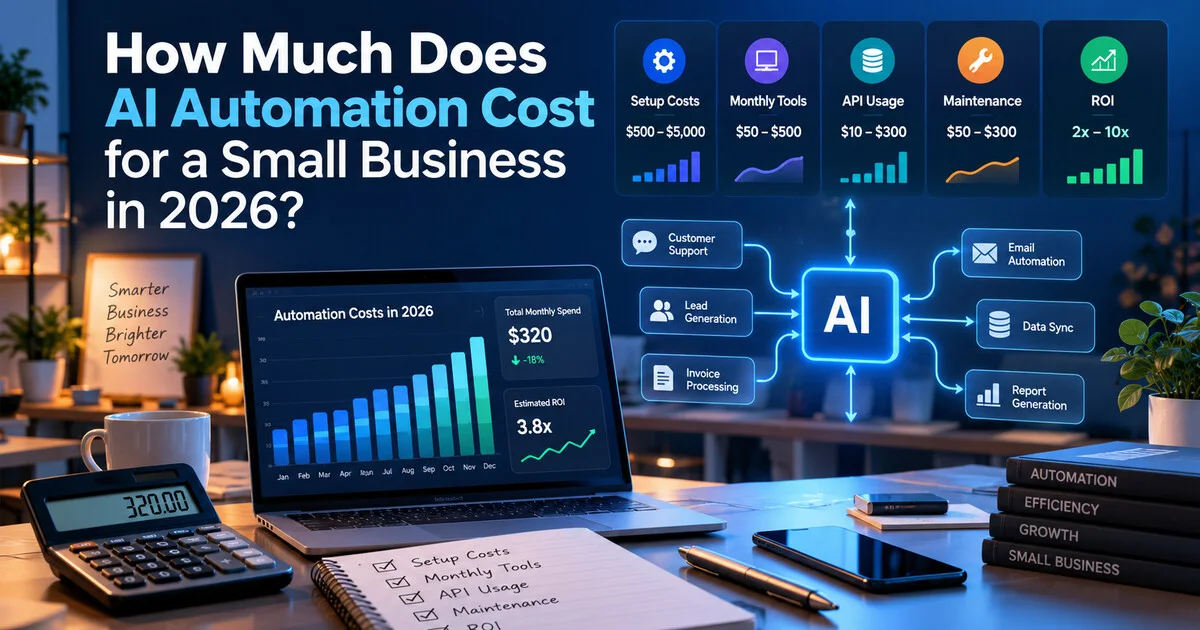
Your business gets enquiries while you're on a job. Customers ask the same questions repeatedly. Someone has to copy information from an email into a CRM, chase quotes, confirm bookings and update records. None of that is particularly complicated. But it takes time, and it pulls people away from work that actually needs their attention. AI automation can help. The question is whether you need a simple workflow, a chatbot connected to your existing systems, or a larger software project.
Those are different jobs. They should not be quoted as though they're the same thing. This guide explains AI automation cost for small businesses in Australia without relying on generic pricing promises. You'll learn what affects implementation, what ongoing costs to consider, how to assess potential ROI and what to ask before hiring an automation agency.
If you're already considering a chatbot or business workflow automation, see our AI automation and chatbot development service.
What does AI automation actually involve? {#what-ai-automation-involves}
AI automation is not one product. It covers different technologies and levels of implementation.
A basic workflow might transfer information from a website enquiry form into a customer management system. A chatbot might answer customer questions, qualify an enquiry and send it to the right person. A more involved system could connect multiple business applications and handle different stages of an operational process.
The distinction matters because the work involved changes considerably.
Consider an Australian plumbing business.
A customer submits an enquiry while the plumber is working on-site. An automated system could collect the customer's details, identify the type of plumbing issue, ask relevant qualifying questions and send the information to the business's existing job-management system.
That is a practical automation opportunity.
However, if the enquiry describes an unusual problem or requires professional judgement, the system should pass it to a person rather than invent an answer. Good automation has boundaries. It should make routine work easier without pretending that every business decision can be handed to software.
Why AI automation implementation costs vary
Two businesses can request something that sounds identical and receive very different implementation proposals.
The reason is usually the underlying scope.
Complexity of the workflow
A straightforward enquiry acknowledgement is different from an automated system that qualifies leads, checks availability, generates quotations and updates several records. Every additional decision, exception and approval requirement adds work.
Existing software and integrations
Your business might already use a CRM, accounting platform, website, booking system or job-management application. The automation needs to communicate with those systems. Some applications offer straightforward integrations. Others require custom development, API configuration or additional testing.
Graphica Pro Artistry's published AI automation service specifically covers integrations with booking software, CRMs and job-management tools.
AI behaviour and training
A chatbot answering a small set of clearly documented questions is different from one that must understand complicated service descriptions, business-specific pricing logic and unusual customer requests. The information supplied to the system matters.
Outdated service details, inconsistent business policies and poorly documented procedures can all create problems during implementation.
Data protection and security
Customer information should never be treated casually. The project may need access controls, appropriate data storage, limited permissions, human approvals and clear rules about what information the AI can process. Australian hosting requirements and your business's privacy obligations should be discussed before development begins.
Testing and ongoing maintenance
A system that works during a demonstration is not necessarily ready for real customers. Testing should cover ordinary enquiries, incomplete information, unexpected questions, integration failures and human escalation. After launch, connected applications can change. Business information also changes. Your automation needs an agreed approach to monitoring and updates.
Setup costs versus ongoing costs
One common mistake is looking only at the initial implementation quote. AI automation has two separate financial considerations: getting the system built and keeping it operational.
Initial implementation
Depending on the project, implementation may involve:
-
Reviewing the existing business process.
-
Identifying suitable automation opportunities.
-
Designing the workflow and decision rules.
-
Configuring the AI model or chatbot.
-
Connecting existing business applications.
-
Preparing business information and response logic.
-
Setting permissions and escalation rules.
-
Testing real-world scenarios.
-
Documenting the system and handing it over.
Not every project needs every item. A basic workflow does not require the same development effort as a custom AI application.
Ask your provider to identify exactly which activities are included.
Ongoing operating costs
Your system may also require:
-
AI model or API usage.
-
Automation platform subscriptions.
-
Hosting and infrastructure.
-
Data storage.
-
Monitoring and error handling.
-
Software updates and integration maintenance.
-
Additional development when business requirements change.
Some of these expenses are charged by external software providers. Others relate to the agency's support arrangement. Do not assume that a completed build includes unlimited future development or maintenance. Ask who owns the software accounts, who pays third-party subscriptions, how usage is measured and what happens if you change providers.
Which type of automation does your business need?
Before requesting proposals, identify what you are actually trying to automate.
Workflow automation
This is generally the sensible starting point for repetitive tasks with predictable rules. Examples include transferring enquiry information, creating customer records, sending notifications and updating business applications. You may not need AI for every step. Standard automation rules can handle predictable actions without involving an AI model.
AI chatbots
A chatbot is useful when customers repeatedly ask questions about services, availability, booking procedures or business information. A properly configured chatbot can qualify enquiries and pass relevant information to your staff. For a trades business, this might mean collecting the customer's location, requested service and preferred appointment details before sending the enquiry to the appropriate person.
It should also know when to stop and ask a human to take over.
Multi-system automation
Some businesses have information spread across several applications. A multi-system workflow might connect a website, CRM, calendar and job-management platform so information does not need to be entered repeatedly. This requires more attention to integration reliability, data consistency and error handling.
Custom AI software
When standard applications cannot support the business process, custom software may be appropriate. This is a different level of work from configuring an existing chatbot. It can involve custom business rules, dashboards, customer portals, data structures and application integrations.
For these projects, see Graphica Pro Artistry's custom software development service.
Scope and inclusions: what should you receive? {#scope-and-inclusions}
A useful proposal describes the work, the boundaries and the responsibilities of each party.
The following table distinguishes the services published by Graphica Pro Artistry from items that a buyer should confirm before proceeding.
| Service | Published scope | What it does not establish | What to confirm |
|---|---|---|---|
| AI chatbots | Business-trained chatbots, enquiry qualification, lead routing and human escalation | Replacement of your customer service team | Channels, knowledge sources, approval rules and escalation method |
| Workflow automation | Connections with booking systems, CRMs and job-management tools | Unlimited integrations or unlimited workflow changes | Applications, API access, workflow steps and failure handling |
| Custom software | CRM systems, portals, dashboards, integrations and business systems | That every existing application or feature is included | Modules, data migration, testing, documentation and ownership |
| ERPNext implementation | ERP configuration with Australian GST and BAS considerations | That every business process is automatically covered | Modules, localisation, migration, hosting and support |
The published AI service also explains that unusual or sensitive enquiries should be escalated to a real person rather than handled through unsupported AI responses.
That is a sensible design principle.
Before accepting a proposal, get the scope in writing. You should know what the system does, what it cannot do, which applications it connects to and who is responsible for maintaining it.
Want to discuss a real business workflow?
Graphica Pro Artistry provides AI chatbot development, workflow automation and system integrations for Australian businesses.
Explore AI automation and chatbot development.
DIY tools or an automation agency?
There is no reason to hire an agency for every automation requirement.
Sometimes an existing software feature or a straightforward workflow tool will do the job.
| Approach | Suitable situation | Main consideration |
|---|---|---|
| Existing software features | Your current applications already support the required task | Check whether the feature meets your actual process requirements |
| DIY automation platforms | Simple workflows with limited integrations | Someone internally must configure, test and maintain them |
| Off-the-shelf AI applications | Standard chatbot or receptionist requirements | Check customisation, data handling and integration limitations |
| Specialist agency | Connected systems, custom workflows or business-specific AI behaviour | Require clear scope, testing, ownership and support arrangements |
| Custom development | Existing products cannot support the required process | Requires proper discovery and technical planning |
My recommendation: start with the smallest solution that solves the actual problem. If an existing booking platform already handles appointment confirmations, you probably do not need a custom AI application to send them. An agency becomes more useful when several applications need to work together, business rules are complicated or the consequences of an incorrect automated action are significant.
Do not buy complexity for the sake of having AI in your business.
Australian business considerations
Automation projects should account for the environment in which your business operates.
GST and accounting
Ask whether supplier proposals and invoices clearly explain GST treatment. Check whether software subscriptions, hosting and external services are billed separately. Your accountant can advise on the appropriate treatment for your business. If you use ERP software, confirm that its Australian configuration supports your actual accounting and reporting requirements.
Graphica Pro Artistry's ERPNext implementation service specifically discusses Australian GST, BAS and related business configuration.
Explore ERPNext implementation for Australian businesses.
Australian Consumer Law
If your automation communicates with customers, the information it provides needs to be accurate and not misleading. A chatbot should not invent service conditions, make unsupported claims or promise something your business cannot deliver. For example, an automated booking assistant should distinguish between a booking request and a confirmed appointment.
Your business remains responsible for how it communicates with customers.
Privacy and customer information
Before connecting customer records to an AI system, establish:
-
What information the system collects.
-
Which applications receive that information.
-
Where information is stored and processed.
-
Who can access conversation records.
-
How long information is retained.
-
What happens when a customer requests access or correction.
-
Whether the system sends information to external AI providers.
Australian Privacy Act obligations depend on your business and circumstances. Do not assume that using an Australian-hosted platform automatically resolves every privacy requirement. Graphica Pro Artistry states that its AI systems are hosted on Australian infrastructure and that access to conversation data is limited.
Metro, regional and trade businesses
A Melbourne-based trades business may need to capture enquiries while staff are travelling between jobs. A regional service provider might need better enquiry collection because customers are spread across a larger service area. A retailer may prioritise product enquiries and customer support instead. The workflow should reflect the way your business actually operates. Copying another company's automation setup is rarely a sensible starting point.
How to calculate AI automation ROI
An automation project should solve a measurable business problem. Do not accept claims that an AI system will automatically increase revenue or eliminate administrative work.
Start with your existing process.
Ask yourself:
-
How much staff time does the task consume?
-
How frequently does it happen?
-
How many people are involved?
-
Where do errors or delays occur?
-
What is the operational impact of those problems?
-
What percentage of the work could realistically be automated?
-
How much human supervision will still be required?
You can estimate the potential value using this framework:
Potential annual time value = recoverable working hours × fully loaded hourly labour cost × working periods.
Then compare that value against the complete cost of implementation, subscriptions, hosting, support and internal supervision. For example, if your team spends substantial time transferring enquiry information between applications, calculate the labour involved before considering automation.
However, recovered time is not automatically additional profit. It only becomes commercially valuable if the business can use that capacity productively. AI automation ROI should be assessed using actual operational records after implementation, not a supplier's hypothetical savings calculation.
Who should reconsider AI automation?
AI automation is not appropriate for every business.
You should reconsider the project if:
-
The process happens rarely and takes little time.
-
Your existing software already solves the problem.
-
Nobody can explain how the current workflow operates.
-
Your business information is incomplete or unreliable.
-
You expect AI to make every decision without supervision.
-
You cannot establish appropriate access and privacy controls.
-
The proposed system has no clear owner or maintenance plan.
-
You expect an AI chatbot to replace experienced staff completely.
There is another warning sign: a supplier promising extraordinary business results without examining your existing systems. A credible provider should be able to explain the limitations of its proposed solution. If the business case does not stack up, do not proceed simply because AI is attracting attention.
Choosing an AI automation provider
A good automation proposal should answer practical questions.
Before signing an agreement, ask:
What exactly will be automated?
Get a clear workflow description. Avoid vague proposals that simply promise an AI-powered business.
Which applications will be connected?
Request a list of the required integrations and any limitations involving your current software.
Who owns the system?
Clarify ownership of source code, configuration, business data and third-party accounts.
How is customer information protected?
Ask about hosting, access permissions, retention and external AI services.
What happens when the system fails?
There should be a clear process for errors, notifications and human intervention.
What ongoing support is included?
Monitoring, software updates, AI usage and additional development are different responsibilities. Make sure the proposal separates them.
Can you test the system before full deployment?
Ask how the provider validates real customer scenarios and confirms that the automation behaves correctly. A trustworthy provider will discuss these questions before pushing you into a larger project.
How Graphica Pro Artistry approaches AI automation
Graphica Pro Artistry is a Melbourne-based web development and digital agency established in 2016, serving Australian businesses from its Broadmeadows office.
Its published AI automation service covers:
-
Chatbots trained on your business services and information.
-
Customer enquiry qualification and routing.
-
Quote and booking automation.
-
Integration with booking software, CRMs and job-management systems.
-
Australian infrastructure hosting.
-
Human escalation when the chatbot cannot confidently handle an enquiry.
The service is particularly relevant to businesses that receive enquiries outside normal operating hours or cannot respond immediately while delivering work. The agency also provides custom software development for businesses that need CRM systems, portals, dashboards or more involved integrations. The important distinction is that a chatbot, an integration and a custom software system are not interchangeable. The correct approach depends on your actual operational requirements.
You can review the published AI automation and chatbot service details before discussing your requirements.
Get a practical assessment of your automation requirements
Graphica Pro Artistry operates from:
12 Dimboola Rd, Broadmeadows VIC 3047, Melbourne, Australia.
For Australian businesses outside Melbourne, consultations and project discussions can also be conducted remotely.
Call 0405 207 904 or email info@graphicaproartistry.com.au.
Explain which business process you want to improve, what software you currently use and where the existing workflow creates problems. The aim should be a clearly scoped solution, not an unnecessary AI project.
Frequently asked questions {#ai-automation-faq}
How much does AI automation cost for a small business in Australia?
There is no responsible single figure that applies to every business. The quote depends on the workflow, number of integrations, AI functionality, data requirements, testing, hosting and ongoing support. Ask for a written scope separating implementation work from recurring software and maintenance responsibilities.
What affects AI automation setup costs?
The main factors include process complexity, existing software, API availability, data quality, AI behaviour, security requirements, testing and the amount of custom development involved. A simple workflow and a multi-system AI application require different levels of work.
Are there ongoing AI automation monthly costs?
Potential recurring expenses include AI usage, hosting, automation platforms, monitoring, maintenance and technical support. Some businesses only need external software subscriptions, while others require an ongoing support arrangement. Confirm what is included in writing.
Is AI automation worth it for a small business?
It can be worthwhile when a repetitive process consumes meaningful staff time, causes avoidable errors or creates delays in customer service. Assess the current workload, realistic time savings and ongoing operating requirements before making a decision.
Is an AI chatbot different from business process automation?
Yes. A chatbot communicates with customers or staff through a conversational interface. Business process automation moves information and performs actions across applications. They can work together, but they are not the same service.
Should a small business use DIY tools or hire an agency?
DIY tools can suit straightforward workflows that someone internally can maintain. An agency is worth considering when integrations, custom business rules, data security or more involved testing require specialist development.
How can Australian businesses protect customer data when using AI?
Review hosting location, access controls, data retention, external AI providers and privacy obligations. Do not enter customer information into an AI service without understanding how that information is handled. Seek appropriate privacy and legal advice where necessary.
Can AI automation integrate with existing CRM and booking systems?
Often, yes. Integration depends on the software's available APIs, permissions and technical limitations. Graphica Pro Artistry's published AI automation service includes integrations with booking systems, CRMs and job-management tools. Confirm the compatibility of your specific applications before proceeding.
When should a business avoid AI automation?
Avoid automating a process that rarely happens, has little operational impact or is already handled effectively by existing software. You should also reconsider any project that lacks a clear business objective, reliable source information or appropriate human oversight.
Final note: AI automation should solve an identifiable business problem. It should not introduce more complexity than it removes.
The right project begins with understanding your workflow, your existing software and the responsibilities the automated system will have. SEO and advertising results vary with competition, budget and market conditions; no agency can guarantee specific rankings or revenue. Be wary of anyone who promises otherwise.